
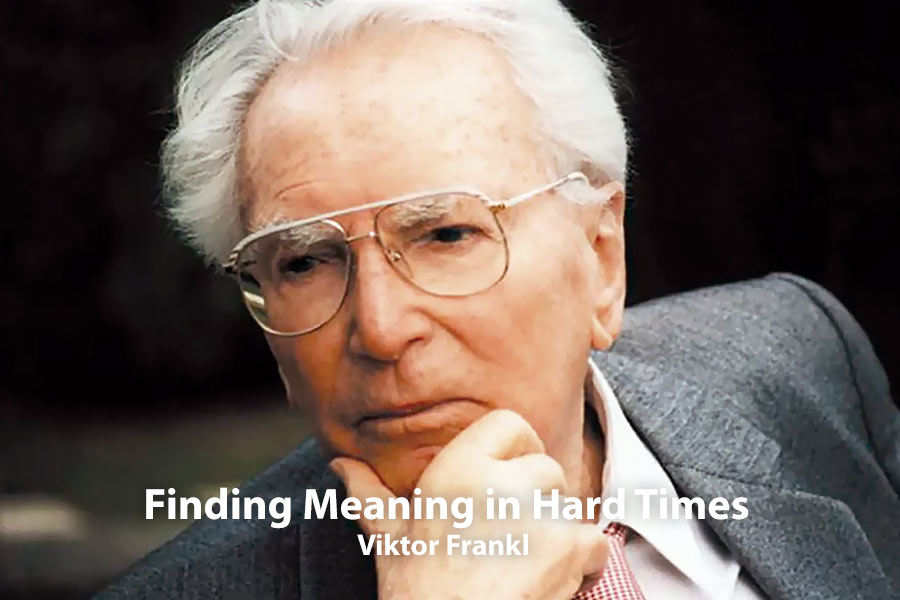
“When one has a why, one can bear almost any how.” – Viktor Frankl
When we communicate with people in moments of strain, the most powerful thing we can offer is not cheerleading but meaning. Viktor Frankl understood this better than anyone. His work, forged in the crucible of the Holocaust, reveals that purpose, not positivity, is what sustains us through hardship.
Today, as we navigate a world filled with uncertainty, stress, and emotional overload, Frankl’s insights offer a blueprint for how to speak with compassion, clarity, and depth. They also help us avoid the modern trap of toxic positivity while embracing the more grounded, life‑affirming stance of tragic optimism.
The Difference Between Toxic Positivity and Tragic Optimism
Toxic positivity is the insistence that people should maintain a positive mindset regardless of their circumstances. It often sounds like:
- “Everything happens for a reason.”
- “Just stay positive.”
- “It could be worse.”
These statements may be well‑intentioned, but they invalidate real emotional experience. They shut down conversation rather than open it.
Tragic Optimism: Frankl’s Alternative
Frankl proposed something far more honest, and powerful: tragic optimism, the ability to maintain hope and find meaning despite pain, loss, and suffering. Tragic optimism does not deny hardship. It does not sugarcoat reality. It does not demand positivity. Instead, it affirms that even in the face of tragedy, life can still hold meaning, purpose, and dignity. Tragic optimism says: “This is painful and life still invites you to respond.”
Why Meaning Matters More Than Positivity
Frankl observed that people who survived the camps were not the strongest or the most optimistic, they were the ones who held onto a why. A reason to endure. A purpose that transcended the moment. Meaning is what allows us to face the “how.”
In communication, this insight is transformative. When someone is struggling, they don’t need us to fix their feelings. They need us to help them reconnect with what gives their life direction.
How Frankl’s Insights Improve Communication in Challenging Situations
- Validate Before You Illuminate
Toxic positivity jumps to solutions. Frankl‑informed communication starts with acknowledgment.
Instead of: “You’ll get through this, stay positive.” Try: “This is incredibly hard, and your feelings make sense.”
Validation creates psychological safety. Safety creates openness. Openness creates the possibility of meaning.
- Help People Reconnect with Their “Why”
Frankl’s central insight is that meaning is not given, it is discovered. You can help someone rediscover their “why” by asking:
- “What matters most to you right now?”
- “What value of yours is being challenged here?”
- “What future outcome are you holding onto?”
These questions don’t deny pain. They illuminate purpose.
- Support Agency Through Small, Wise Actions
Tragic optimism is active. It invites people to take steps, even small ones, toward what they can control.
You might say: “Given everything you’re facing, what’s one small step that feels doable?”
Agency restores dignity. Dignity restores momentum.
- Honor Emotional Duality
People can feel grief and gratitude. Fear and courage. Exhaustion and determination. Frankl teaches us that suffering and meaning can coexist. Your communication should make room for both.
Practical Communication Shifts You Can Use Today
- Replace reassurance with resonance. “I hear how heavy this feels.”
- Shift from silver linings to meaning making. “What does this situation ask of you?”
- Invite reflection without forcing it. “When you’re ready, we can explore what this might mean for you.”
- Affirm strength without denying struggle. “You’ve carried hard things before, and you’re not carrying this alone.”
Frankl’s work reminds us that meaning, not forced positivity, is what sustains people through hardship. When we communicate with tragic optimism, we honor the full human experience: the darkness and the light, the pain and the possibility.
We help others find their “why,” and in doing so, we help them rediscover the strength to face any “how.”