
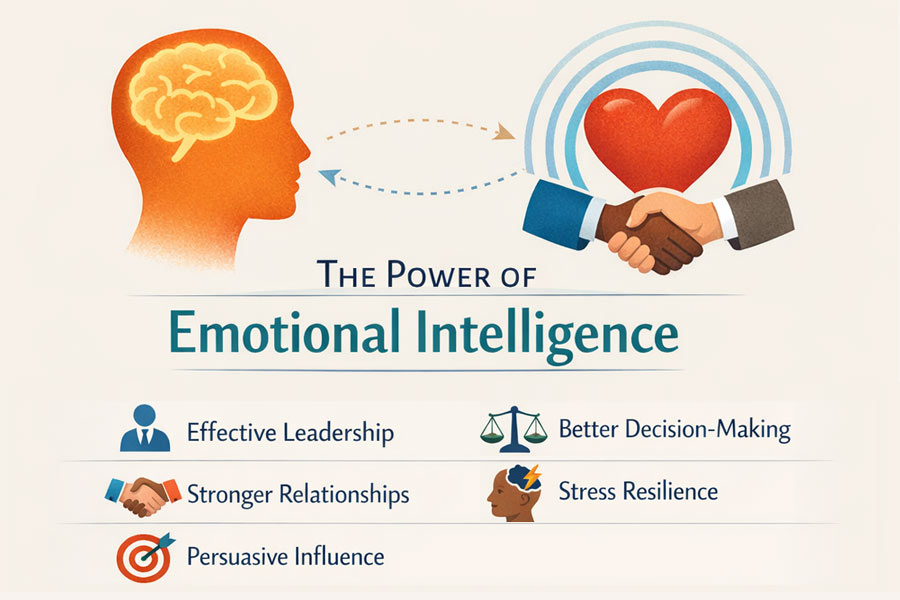
A growing body of research shows that emotional intelligence (EI) is a stronger predictor of long-term success than raw cognitive ability.
- EI Drives Leadership Effectiveness
Studies across industries show that top-performing leaders consistently score higher in emotional intelligence than their peers. They communicate more clearly, resolve conflict more effectively, and create environments where people feel understood and motivated.
- EI Strengthens Relationships
Whether in business or personal life, relationships thrive on trust, empathy, and attunement. People with high EI read social cues more accurately and respond in ways that build connection rather than friction.
- EI Fuels Persuasion and Influence
Persuasion is not about delivering more information; it’s about delivering the right information in a way that resonates emotionally. EI helps communicators understand what matters to others and tailor their message accordingly.
- EI Supports Better Decision-Making
Contrary to the myth that emotions cloud judgment, emotional intelligence helps people integrate emotional data with rational analysis. This leads to more grounded, human-centered decisions.
- EI Predicts Performance in High-Stress Roles
In fields like healthcare, sales, and leadership, the ability to stay composed, empathetic, and adaptable under pressure is often more valuable than technical expertise alone.
Persuasive Communication Training Builds Emotional Intelligence
While some people seem naturally attuned to others, emotional intelligence is not an innate gift; it’s a skill set. As with any skill, it can be strengthened through deliberate practice.
Persuasive communication training is one of the most effective ways to develop EI because it empowers individuals to:
- Practice Deep Listening
True persuasion begins with understanding. Training that emphasizes listening, rather than talking, helps people tune into emotional cues, motivations, and unspoken concerns.
- Build Empathy Through Perspective-Taking
Persuasion frameworks often require communicators to step into the other person’s world. This strengthens empathy, one of the core pillars of emotional intelligence.
- Regulate Emotional Responses
Difficult conversations, objections, and high-stakes interactions demand emotional self-management. Communication training teaches people to stay grounded, curious, and constructive.
- Communicate With Clarity and Attunement
Emotionally intelligent communicators adjust their tone, pacing, and message structure based on the listener’s needs. Training helps people become more intentional and adaptive.
- Develop Confidence Without Aggression
Persuasion is not force. It’s alignment. Training helps individuals express themselves with confidence while maintaining respect and psychological safety.
Emotional intelligence is not simply a “nice-to-have.”
EI is a core competency for anyone who wants to lead effectively, build trust, or influence others with integrity. Because EI can be developed, the path forward is clear:
- Learn to listen deeply
- Understand emotional cues
- Communicate with empathy
- Regulate your reactions
- Practice attuned, human-centered, persuasion
In a world overflowing with information, it’s emotional intelligence, not IQ, that determines who gets heard, who gets trusted, and who ultimately makes an impact.