
AIM Dental Marketing®

AIM Marketing

Empathy and Rapport

Empathy and Rapport

The Indispensable Engines Behind
Caring, Connection, and Collaboration

In every workshop, keynote, and coaching session, I emphasize that persuasive communication is not primarily about language; it’s about relationship. Two relational forces reside in the heart of The Persuasion Blueprint™: empathy and rapport.

They are often mentioned together, sometimes even used interchangeably, but they are not the same. Understanding the difference, and how they work together, is essential for anyone who wants to communicate with clarity, compassion, and conviction. Let’s start at the beginning.

What Is Empathy?

Empathy is the ability to understand and share the feelings, perspectives, or experiences of another person. The word comes from the German Einfühlung, “feeling into”, coined in the late 19th century to describe the human capacity to imaginatively enter someone else’s emotional world.

Empathy is internal. It’s a mindset, a posture, a willingness to step outside your own frame of reference and into someone else’s.

Empathy asks: “What is it like to be them right now?”

Empathy is not a single skill. It’s a cluster of abilities that lets you understand another person’s internal experience. But understanding alone isn’t enough. If the other person doesn’t feel understood, your empathy remains a well-kept secret.

There are three forms of empathy. Each plays a different role in persuasive communication.

Cognitive Empathy is the ability to understand another person’s thoughts, perspectives, motivations, and internal logic. It helps you map the other person’s worldview. Cognitive empathy also allows you to anticipate objections and tailor your message. Finally, it supports clarity because you know what will land and what will confuse. A downside of cognitive empathy is that it is invisible unless paired with a felt signal of caring. It can also come across as cold, strategic, or manipulative. Without emotional or afferent empathy (see below), it stays “in your head” and never reaches theirs. In other words, cognitive empathy helps you aim your message, but it doesn’t make the other person feel understood.

Emotional Empathy is the ability to feel what another person is feeling. Emotional empathy creates genuine emotional alignment. It helps you respond with sensitivity and timing and reduces missteps because you can sense the emotional temperature. It can also overwhelm you if you absorb too much too soon. It can lead to over-identification and loss of objectivity, and does not guarantee the other person knows you feel with them. Emotional empathy helps you tune in, but it doesn’t automatically transmit that attunement.

Afferent Empathy is the ability to transmit caring, attunement, and understanding in a way the other person actually feels. It is empathy that gets delivered to their world instead of simply residing in yours.  The proper application of afferent empathy in persuasion makes caring perceptible, lowers defensiveness and increases psychological safety. It turns cognitive and emotional empathy into something the other person can receive and, because your counterpart senses your intention, it can build trust rapidly,. Challenges associated with afferent empathy are that it requires your emotional regulation; you can’t transmit caring if you’re dysregulated yourself. It requires courage and presence; many people retreat into intellect instead. Without skill, it can feel inconsistent or ungrounded.

Afferent empathy is the delivery system for the other forms of empathy. Without it, cognitive and emotional empathy remain a well-kept secret.

Persuasive communication is not powered by what you know or even what you feel. It is powered by what the other person can sense, receive, and trust.

To summarize, cognitive empathy helps you understand them, emotional empathy helps you feel with them, and afferent empathy helps them feel you feeling them. This final step is what transforms empathy from a private experience into a relational force. It is the emotional foundation of trust, safety, and attunement.

Rapport is the sense of harmony, ease, and mutual responsiveness that emerges between people when communication flows naturally. The term comes from the French rapporter, “to bring back” or “to relate.”

Rapport is external. It’s the observable quality of the interaction, the rhythm, the tone, the comfort, the sense that “we’re in sync.”

Rapport asks: “Are we aligned enough to communicate effectively?” It is the social bridge that allows empathy to be expressed and received. Empathy is the engine. Rapport is the road. One without the other is incomplete. Empathy without rapport stays private; you understand them, but they don’t feel understood. Rapport without empathy becomes superficial; pleasant, but not meaningful. This is illustrated when someone says of another “He’s a good guy but…” The ‘but’ suggests a lack of connection.

The Persuasion Blueprint™ rests on three pillars: Caring, Connection, and Collaboration. Empathy and rapport are the forces that make each pillar work.

Caring begins with the decision to understand someone’s needs, fears, hopes, and motivations. If the emotion you choose for yourself is curiosity, compassion, or respect, your words will naturally follow suit. Rapport communicates that care in a way the other person can feel: warm tone, open body language, attentive listening, matching pace and energy, and asking questions that show genuine interest. 

For example, A dental team member senses a patient’s anxiety (empathy) and slows their pace, softens their tone, and checks in gently (rapport). The patient relaxes. Caring becomes visible.

Connection requires seeing the world through their eyes. What do they value? What are they worried about? What outcome are they hoping for? Empathy gives you the map. Rapport is what allows people to open up, share, and engage by: mirroring language, finding common ground, demonstrating presence, responding rather than reacting.

For example, A neighbor at a recent garage sale I staged mentioned they were looking for a starter set of golf clubs for their teenager. I sensed the pride and hope behind the comment (empathy). I responded with enthusiasm, asked about their teen’s interests, and shared a story about my experience with the clubs (rapport). Instead of selling, I was connecting.

Collaboration requires understanding not just what you want, but what they want, and where those interests overlap. Empathy reveals the intersection. People collaborate when they feel safe, respected, and valued. Rapport creates that environment: transparency, mutual respect, positive tone, and shared (responsive) enthusiasm.

For example, on a recent event with a local hiking group, I made the acquaintance of a woman who seemed like she enjoyed challenging herself physically. She mentioned she’d competed in a couple of marathons. I sensed her excitement and pride (empathy). I matched her energy, asked follow-up questions, and shared my work with the Climb for a Cause Foundation (rapport). A new partnership emerged, not because I pushed, but because I aligned.

Empathy and rapport are not “soft skills.” They are strategic assets, the emotional and relational infrastructure that makes The Persuasion Blueprint™ work.

  • Caring becomes credible when empathy guides your intention and rapport shapes your delivery.
  • Connection becomes meaningful when empathy reveals what matters and rapport creates the space to explore it.
  • Collaboration becomes natural when empathy aligns interests and rapport aligns people.

When you combine empathy and rapport, you create communication that is not only persuasive, but human, ethical, and lasting. It all begins the moment you decide to choose your emotion before choosing your words. 

AIM MarketingEmpathy and Rapport
read more
The Art of Asking

The Art of Asking

How the Right Questions, Asked the Right Way,
Create Rapid and Meaningful Connection

Most people think persuasion begins with talking. Professionals who consistently create trust, influence, and collaboration know the opposite is true.

Persuasion begins with the questions you ask and, even more importantly, how and when you ask them.

When you ask the right kind of question, in the right way, at the right time, something powerful happens: your counterpart reveals their felt needs, the emotional drivers beneath their words, positions, and behaviors. Once those needs surface, connection accelerates, resistance drops, and collaboration becomes the natural next step.

This is the heart of The Persuasion Blueprint.

Why Questions Are the Fastest Route to Connection

Every human being carries an invisible backpack filled with: concerns, hopes, fears, frustrations, desires, and unspoken expectations. Most conversations never get past the surface. People trade information but not meaning. They exchange words but not understanding. Their communication is transactional, instead of relational.

The right question changes that dynamic instantly. A well‑timed, well‑framed question signals that you are: paying attention, curious about their experience, not here to win, but to understand.

This is the moment your counterpart feels seen, heard, and safe; the three conditions required for genuine connection.

The Three Dimensions of a High‑Impact Question

1. The Right Kind of Question

Not all questions are created equal. Some interrogate. Some intimidate. Some shut people down. The questions that open people up share three qualities:

  • They are open‑ended. (“What’s most important to you about…?”)
  • They are non‑judgmental. (“How are you feeling about the direction things are going?”)
  • They invite reflection rather than defense. (“What’s the part of this that matters most to you personally?”)

These questions don’t simply extract information; they reveal meaning.

2. Asked in the Right Way

Tone and framing matter as much as the words.

A question asked with curiosity lands differently than the same question asked with urgency or skepticism.

The right way includes: a calm, steady tone, a posture of genuine interest, a pace that gives the other person room to think, a facial expression that communicates openness rather than evaluation. When your delivery is attuned, your counterpart feels safe enough to go deeper. For more on this, check out my blog on mirror neurons.

3. Asked at the Right Time

Timing is the difference between a breakthrough and a breakdown. Ask too early, and the question feels intrusive. Ask too late, and the moment has passed. The right time is usually: after you’ve demonstrated listening, reflected back what you heard, before offering advice, solutions, or opinions. This sequencing tells your counterpart: Your experience matters more than my agenda.

How Questions Reveal Felt Needs

A “felt need” is the emotional truth beneath the surface-level request. For more on this check out my blog on Facts vs. Truth.

Examples include:

Statement: “I need more time.” Meaning: I’m overwhelmed and afraid of disappointing someone.

Statement: “I’m not sure this is the right direction.” Meaning: I need clarity and reassurance.

Statement: “I don’t think this will work.” Meaning: I need to feel safe before committing.

People rarely state these needs directly. But they will show them if you ask the right questions. Here are a few that reliably uncover felt needs, such as those above:

“What’s the real challenge for you here?”

“What part of this matters most to you personally?”

“What are you hoping will happen as a result of this?”

“What would feeling supported look like for you right now”

When someone answers these questions, they’re not giving you data; they’re revealing themselves to you.

Why This Leads to Faster, Deeper Connection

Once you understand someone’s felt need, you can reflect it back in a way that communicates: “I get you.” Not “I agree with you.” “I can fix this for you.” or “I’ve felt that way too.” It tells your counterpart “I see what matters to you, and I respect it.” This is the moment trust forms, defenses drop, and collaboration becomes possible.

Connection isn’t built by impressing people. It’s built by understanding them.

Asking the right questions is not merely a technique; it’s a discipline, a mindset, a commitment to curiosity over control.

When you master the art of asking: conversations deepen, trust accelerates, resistance dissolves, and collaboration emerges naturally. Most importantly, you create the kind of connection that makes people feel understood, not because you told them who they are, but because you helped them discover it for themselves.

AIM MarketingThe Art of Asking
read more
What, In Fact, Is Your Truth?

What, In Fact, Is Your Truth?

Understanding the difference between facts and truth is one of the most transformative, but underutilized, skills in persuasive communication.

Facts describe reality. Truth describes meaning. Persuasion requires fluency in both.

Facts are: observable, measurable, and independently verifiable. For example, “Our practice saw a 12% drop in new patients last month.” Or “Your appointment was at 3:00 PM. You arrived at 3:20.” Someone’s Truth is subjective, emotional, and laden with meaning. Truth sounds like “We feel like we’re losing momentum.” Or “I felt disrespected when you arrived 20 minutes late.”

A fact is what happened. A truth is what it meant to the person experiencing it. Persuasion collapses when communicators treat these as interchangeable because people act on their truth, not the facts. You can present flawless data, airtight logic, and impeccable evidence, and still fail to connect with your counterpart because humans make decisions based on felt meaning, then justify it with facts afterward. If you ignore someone’s truth, they experience you as dismissive, defensive, and disconnected. When you honor their truth, they experience you as attuned, trustworthy, and collaborative.

When someone feels seen in their truth, their nervous system shifts from defense to openness. Only then do facts land. This is why persuasion is fundamentally an emotional process before it becomes a cognitive one. The Persuasion Blueprint is built on Caring, Connection, and Collaboration. This ‘facts–truth distinction’ maps cleanly onto each pillar:

Caring

Caring is emotional attunement. You demonstrate caring when you validate the person’s truth before introducing facts. For example, instead of saying “Your appointment was at 3:00. You did not arrive until 3:20.” begin with: “It sounds like you felt rushed and frustrated getting here today.” This doesn’t concede the facts. It acknowledges their truth.

Connection

Connection is where you integrate both your world and theirs. You create connection by acknowledging their truth, sharing your facts, and aligning on meaning. For example: “While I’m sure there was a reasonable explanation, your delayed arrival made it a challenge for us to see you today. May we work together to try and avoid a recurrence?” Connection says: “I understand and respect your reality and am committed to a more favorable outcome.”

Collaboration

Collaboration is co‑creating a path forward. Once truth is honored and facts are clarified, people are ready to collaborate. For example, “Given what we’ve both shared, what would help this feel better next time?” Collaboration says: “Let’s build the solution together.” It’s where persuasion becomes partnership.

Master communicators persuade by honoring truths, not merely presenting facts. When you speak to someone’s truth: resistance drops, rapport increases, influence rises, and alignment accelerates.

AIM MarketingWhat, In Fact, Is Your Truth?
read more
The Hidden Engine of Human Connection

The Hidden Engine of Human Connection

How Mirror Neurons Elevate Ethical Persuasion

Communication is often described as an art, but beneath the artistry lies a powerful neurological engine that shapes how people connect, collaborate, and change. That engine is the mirror-neuron system, a network in the brain that activates, not only when we perform an action, but also when we observe someone else performing it.

For leaders, coaches, and anyone committed to ethical influence, understanding mirror neurons isn’t optional. It’s foundational. They are the biological bridge between intention and impact, between what we mean and what others feel.

In my work with The Persuasion Blueprint, mirror-neuron activation is one of the quiet forces that makes emotional regulation, attunement, and ethical storytelling so effective. When we communicate with clarity and calm, we don’t just transmit information; we transmit states. And the listener’s brain, through mirror neurons, begins to align with ours.

Let’s explore how this works, why it matters, and how you can apply it immediately.

What Mirror Neurons Are,
and Why They Matter in Communication

Mirror neurons were first discovered in the early 1990s by neuroscientists studying macaque monkeys. They noticed that certain neurons fired both when a monkey grasped an object and when it watched another monkey grasp the same object.

Humans have a far more complex version of this system. It underlies:

  • Empathy
  • Rapport
  • Emotional contagion
  • Social learning
  • Nonverbal synchrony
  • Intuitive understanding of others’ intentions

In communication, mirror neurons help us “simulate” the internal state of the person we’re interacting with. 

This is why:

  • You feel calmer around someone who is calm
  • You tense up when someone is angry
  • You lean in when someone speaks softly
  • You smile when someone else smiles

We don’t consciously choose these responses. Our brains do it automatically.

This is also why emotional regulation is not just a personal skill, it’s a leadership skill. When you regulate yourself, you regulate the room.

The Mirror Neuron Loop

Here’s an illustration of this process:

The speaker’s state triggers the listener’s mirror neurons, which affects the listener’s state, resulting in a change in the listener’s behavior, and the speaker’s response results in a reinforced loop.

This loop can spiral upward or downward.

  • If you’re grounded, curious, and calm, the listener’s brain mirrors that state.
  • If you’re tense, rushed, or defensive, the listener’s brain mirrors that too.

The loop is always running. The only question is whether it’s working for or against you.

The Benefits of Activating Mirror Neurons Intentionally

  1. Rapid Rapport and Trust

People trust those who feel familiar, aligned, and attuned. When your tone, posture, and emotional state are steady, the listener’s mirror neurons help them feel steady too. This creates a sense of psychological safety, which is essential for influence.

  1. Reduced Defensiveness

A regulated nervous system is more receptive.
When you slow your breathing, soften your voice, or pause intentionally, the listener often mirrors these cues. Their threat response decreases, and their capacity for reasoning increases.

  1. Enhanced Empathy and Understanding

Mirror neurons help people “feel felt.”
This is the neurological basis for deep listening and attunement, skills that transform conflict into collaboration.

  1. Ethical Persuasion Becomes Easier

When someone feels aligned with you, they’re more open to your ideas. This is not manipulation. It’s resonance. Ethical persuasion is not about overpowering someone’s mind, it’s about aligning with it.

  1. Better Learning and Retention

Humans learn by imitation. When you model emotional regulation, clarity, and curiosity, your audience internalizes those states. This is why scenario-based coaching (aka role play) is so effective: it activates the learner’s mirror-neuron system.

  1. Stronger Nonverbal Synchrony

People unconsciously mirror gestures, posture, facial expressions, and vocal rhythm. This synchrony creates conversational “flow,” making communication feel natural and collaborative.

  1. Improved Outcomes in High-Stakes
        Conversations

Whether you’re leading a team, coaching a client, or navigating conflict, mirror-neuron activation helps:

  • de-escalate tension
  • build shared understanding
  • increase cooperation
  • move toward solutions

It’s a neurological shortcut to alignment.

How The Persuasion Blueprint™ (TPB) Activates Mirror Neurons

The framework activates mirror neurons in several, if subtle, ways. Examples include:

Emotional Regulation
When you regulate your own state, you regulate the listener’s state through mirror-neuron activation.

Attunement and Listening
Attunement activates the listener’s empathy circuits, making them more open and collaborative.

Ethical Storytelling
Stories activate sensory and emotional regions in the listener’s brain, allowing them to “experience” the narrative with you.

Scenario-Based Coaching
Scenarios engage the learner’s mirror-neuron system, enabling them to mentally rehearse behaviors before performing them.

Mirror neurons are the biological foundation that makes these modules work.

Practical Exercises to Strengthen Mirror-Neuron Activation

These exercises are designed for leaders, coaches, and communicators who want to apply this immediately.

Exercise 1: The Regulation Ripple

Purpose: Train your nervous system to influence others’ nervous systems.

  1. Sit with your feet grounded.
  2. Take three slow breaths, exhaling longer than you inhale.
  3. Relax your shoulders and soften your jaw.
  4. Speak a simple sentence aloud:
    “I’m here, and I’m listening.”
  5. Notice how your body feels.
  6. Now imagine someone across from you mirroring that state.

Use this before any high-stakes conversation.

Exercise 2: The Attunement Scan

Purpose: Strengthen your ability to read and respond to nonverbal cues.

During your next conversation, silently scan for:

  • posture
  • breathing rhythm
  • facial tension
  • vocal pace
  • eye movement

Then adjust your own state, not to mimic, but to meet the other person where they are.  This activates rapport without forcing it.

Exercise 3: The Story Embodiment Technique

Purpose: Use storytelling to activate the listener’s sensory and emotional circuits.

  1. Choose a short story you often tell.
  2. Practice telling it while embodying the emotional arc: calm, curious, hopeful, resolved.
  3. Notice how your body shifts as you speak.
  4. Deliver the story to someone else and observe their nonverbal response.

This is how ethical storytelling becomes a felt experience, not just a narrative.

Exercise 4: The Mirror-Neuron Reset

Purpose: Interrupt negative emotional contagion.

When you sense tension rising:

  1. Pause.
  2. Take one slow breath.
  3. Lower your shoulders.
  4. Speak 10% slower.

This resets the mirror-neuron loop and invites the other person into a calmer state.

Final Thoughts

Mirror neurons remind us that communication is not merely an exchange of words; it’s an exchange of states.  When we communicate with intention, regulation, and empathy, we activate the listener’s mirror-neuron system in ways that build trust, deepen connection, and open the door to ethical persuasion.

Influence begins with the state you create in yourself.

AIM MarketingThe Hidden Engine of Human Connection
read more
Cold Calling: Boon or Bane?

Cold Calling: Boon or Bane?

How the Persuasion Blueprint Turns Gatekeepers into Allies and Shortens the Path to Real Conversations

Cold calling remains one of the toughest challenges in sales. Rejection rates are high, attention spans are short, and gatekeepers stand like sentinels protecting decision-makers.

Yet top performers consistently break through, not with aggressive scripts or tricks, but by building genuine trust from the very first interaction.

The Persuasion Blueprint™ (TPB) offers a powerful framework built on three core distinctions: Caring, Connection, and Collaboration. These elements transform everyday conversations into engines of trust and results. They are especially effective in cold calling, where the human element often gets overlooked in favor of features and benefits.

Recognize the “Pre-Prospect”: Your First Real Opportunity

The person who answers the phone, the receptionist or assistant, often referred to as the screener or gatekeeper, is rarely the final decision-maker.  Perhaps because of this, some salespeople treat them as obstacles to bypass as quickly as possible. This is a critical mistake.

Call them what they are: your pre-prospect. They control access, have influence within the organization, and form their own impressions of you and your company. Disrespect their role, and doors slam shut. Treat them with genuine respect, and they can become your strongest advocate.

TPB begins with Caring.  It’s not what you say, but what the other person feels from the interaction, that matters. When you demonstrate that you truly care about their time, their challenges, and their job, you create an emotional foundation that scripts alone can’t replicate.

Apply the Three Cs with Gatekeepers


  1. Caring: Show You Value Them and Their Role

Begin by acknowledging their position and the pressure they’re under:

“Hi, this is [Your Name] with [Your Company]. I know you’re busy protecting [Prospect’s] time, and I’m sure he/she appreciates how much you do to keep things running smoothly. I promise I’ll be respectful of that.”

This simple act of empathy fills the “care gap” that is a hallmark of TPB. People feel when you’re genuine versus when you’re just trying to push past them. Caring disarms defensiveness and opens the door to real dialogue.

  1. Connection: Earn Trust by Demonstrating You “Get It”

Once you’ve shown basic respect, build connection by relating to their world:

  • Ask a light, open-ended question about their experience.
  • Reference common challenges in their industry or role.
  • Position yourself as someone who helps, not sells.

The goal is for them to feel: “This person actually understands my situation and isn’t just another pushy caller.”

Connection happens when the pre-prospect senses you’re the one who gets it, and that working with you could make their job easier, or make them look even better to their employer.

  1. Collaboration: Get Agreement to Move Forward Together

Now shift to collaboration, the moment they move from “maybe” to “I’m in.” Seek mutual agreement rather than demanding a transfer:

“Would it make sense for me to share briefly what we’ve been doing for other [similar companies/roles], and see if it might be worth a quick conversation with [Prospect’s Name]? I only need about 30 seconds of his/her and, if it’s not a fit, I’ll respect that completely.”

This collaborative approach gives them ownership. They’re not just passing along a message; they’re making a thoughtful decision because they trust you care and that it could be valuable.

Once You Reach the Prospect: Respect Their Time Immediately

The tone you set with the gatekeeper carries forward.  Once you get the prospect on the line, reinforce the same principles:

“Thanks for taking my call.  I know your time is valuable. I’ll be very brief. I just wanted to see if it might make sense to explore further whether there could be a good fit here. Do you have about 30 seconds?”

This respects their boundaries, while inviting collaboration. It signals you’re not there to waste time with a monologue, but to have a meaningful, two-way conversation.

From there, continue cycling through Caring (empathize with their challenges), Connection (show you understand their specific situation), and Collaboration (guide them toward next steps together).

Why This Works Better Than Traditional Cold Calling Scripts

Traditional approaches often feel manipulative or self-serving. The Persuasion Blueprint flips the script: it’s ethical, human-centered persuasion that aligns with how people actually make decisions—first emotionally, then logically.

By treating pre-prospects with genuine care and respect:

  • You reduce immediate resistance.
  • You turn potential blockers into allies who may even advocate for you.
  • You create a consistent trust-building process that improves conversion rates and reduces burnout from hostile interactions.
  • You differentiate yourself in a world full of robotic, feature-pushing callers.

Salespeople who master these distinctions report not just better results, but more fulfilling conversations and stronger pipelines built on real relationships rather than transactions.

Persuasion as a Skill You Can Build

Cold calling doesn’t have to feel like a grind. When you internalize the Persuasion Blueprint’s focus on Caring, Connection, and Collaboration, every interaction becomes an opportunity to build trust, starting with the gatekeeper who holds the keys to your prospect.

The pre-prospect isn’t an obstacle. They’re your first chance to demonstrate the value you bring. Earn their trust and respect, secure their collaborative buy-in, and watch more doors, and real opportunities, open.

If you’re ready to transform how your team handles cold outreach and every other critical conversation, explore the Persuasion Blueprint further. The results speak for themselves: better connections, higher close rates, and conversations that feel natural instead of forced.

What’s one small shift you could make in your next cold call to show more Caring?

AIM MarketingCold Calling: Boon or Bane?
read more
The Hidden Power of Enthusiasm in Conversations

The Hidden Power of Enthusiasm in Conversations

How It Fuels (or Breaks) Persuasive Communication

In my work coaching leaders and teams through The Persuasion Blueprint, one truth stands out again and again: persuasion isn’t about slick scripts or forceful arguments. It’s about turning everyday conversations into engines of caring, connection, and collaboration (the Three Cs).

At the heart of this framework is a simple but profound shift: “It’s not what you say, it’s what they feel.” When your counterpart feels genuinely cared for, truly understood, and invited into real collaboration, the “maybe” turns into an enthusiastic “I’m in.” Referrals follow. Loyalty deepens. Results compound.

But there’s a subtle element that can either supercharge these Three Cs or undermine them:

Enthusiasm.

Too many people misuse it. They pump themselves up about their ideas, their offer, or their agenda and unleash it like a fireworks show. It feels energetic to them but to the other person, it can land as overwhelming, inauthentic, or even dismissive.

The key? Enthusiasm in persuasion is ideally responsive. You wait to sense it from, or subtly kindle it for, your counterpart first, then mirror, amplify, and align with it.

When done right, it becomes a bridge that strengthens caring, deepens connection, and accelerates collaboration.

Understanding Enthusiasm in Conversation

Enthusiasm isn’t just volume or smiles. It’s an emotional energy that signals investment, optimism, and shared possibility. It shows up in tone, body language, pacing, word choice, and responsiveness.

Depending on how it’s used, it can either build or break persuasive communication.

The Negative Forms of Enthusiasm (What Breaks Persuasion)

These are the patterns that feel energetic to the speaker but draining or disconnecting to the listener.

  1. Over-the-Top or Forced Enthusiasm

Exaggerated cheer, relentless positivity, or hype that doesn’t match the moment or the other person’s energy.

How it hinders: It erodes credibility and caring. People feel manipulated, pressured, or exhausted. Authenticity, the foundation of the Blueprint, disappears.

  1. Self-Directed Enthusiasm (The “Me-First” Spark)

Excitement centered entirely on your ideas, your offering, your vision. You talk faster, gesture bigger, and lean in with high energy about what you love and believe.

How it hinders:

  • It makes the other person feel like a spectator rather than a participant.
  • It broadcasts “I’m excited, so you should be too,” instead of “I see you.”
  • It breaks caring because it’s about your feelings, not theirs.
  • It diminishes connection because they don’t feel “gotten.”
  • It derails collaboration because the conversation becomes one-way.

When it can help: Only when the other person already shares the exact same excitement and you’re simply matching it.

  1. Misaligned Analytical Enthusiasm

Quiet intensity and curiosity can be powerful but when practiced on a high-energy counterpart, it can feel cold or detached. Your counterpart may interpret your focused, subtle energy as disinterest or lack of warmth.

The Positive Forms of Enthusiasm (What Builds Persuasion)

These forms align with the Three Cs and elevate the conversation.

  1. Empathetic Enthusiasm (Warm Support + Shared Joy)

A blend of emotional intelligence and positivity. You express genuine delight in their wins, their challenges overcome, their aspirations.

Impact:

  • It strengthens caring by making the conversation relational, not transactional.
  • It builds connection when it’s authentic and grounded.
  • It opens the door to collaboration.
  1. Aligned Analytical Enthusiasm

This form of enthusiasm is characterized by thoughtful questions, precise follow-up, and shared excitement in uncovering insights.  It is appropriate when used with a lower energy, detail-oriented and analytical counterpart. 

Impact:

  • It respects and acknowledges a specific communication style.
  • It builds trust through intellectual alignment.
  • It helps detail-oriented counterparts feel seen and valued.
  1. Responsive Enthusiasm

You listen first, notice cues of interest or energy, and then match or gently amplify them.

Impact:

  • Caring: It shows attunement to what matters to your counterpart.
  • Connection: It signals “I get it and I’m right here with you.”
  • Collaboration: It creates momentum and co-creation.
  1. Shared or Contagious Enthusiasm

When both parties’ energies align and build on each other organically.

Impact:

  • Ideas compound
  • Objections dissolve.
  • “I’m in” becomes the natural next step.

Here’s how enthusiasm helps reframe persuasion as ethical influence through the Three Cs:

  • Caring: Enthusiasm stems from genuine care for what the other person feels and needs.
  • Connection: Mirroring their enthusiasm creates emotional alignment.
  • Collaboration: Aligned enthusiasm turns dialogue into partnership.

Enthusiasm in persuasion isn’t something you inject; it’s something you sense and to which you respond.

Wait for their spark. Reflect it back. Build from there.

That’s how you create raving fans and turn conversations into referrals.

Practical Ways to Master Enthusiasm in Your Conversations

  1. Pause and Observe: Notice their cues before adding energy.
  2. Match, Then Lead: Align with their tone, then build together.
  3. Practice Responsiveness: Hold back your excitement until you see theirs.
  4. Adapt to Style: Warmth for high-energy people; curiosity for analytical ones.
  5. Use Your Persuasion Scorecard: Spot where enthusiasm is helping or hurting trust, and adjust accordingly.

Mastering these nuances doesn’t just make you more persuasive, it makes you a better leader, colleague, partner, and friend.

If your team is ready to turn conversations into collaboration (and revenue), explore The Persuasion Blueprint coaching programs or the free Persuasion Scorecard. Let’s turn high stakes conversations into something extraordinary!

AIM MarketingThe Hidden Power of Enthusiasm in Conversations
read more
Finding Meaning in Hard Times: What Viktor Frankl Teaches Us About Communication, Toxic Positivity & Tragic Optimism

Finding Meaning in Hard Times: What Viktor Frankl Teaches Us About Communication, Toxic Positivity & Tragic Optimism

“When one has a why, one can bear almost any how.” – Viktor Frankl

When we communicate with people in moments of strain, the most powerful thing we can offer is not cheerleading but meaning. Viktor Frankl understood this better than anyone. His work, forged in the crucible of the Holocaust, reveals that purpose, not positivity, is what sustains us through hardship.

Today, as we navigate a world filled with uncertainty, stress, and emotional overload, Frankl’s insights offer a blueprint for how to speak with compassion, clarity, and depth. They also help us avoid the modern trap of toxic positivity while embracing the more grounded, life‑affirming stance of tragic optimism.

The Difference Between Toxic Positivity and Tragic Optimism

Toxic positivity is the insistence that people should maintain a positive mindset regardless of their circumstances. It often sounds like:

  • “Everything happens for a reason.”
  • “Just stay positive.”
  • “It could be worse.”

These statements may be well‑intentioned, but they invalidate real emotional experience. They shut down conversation rather than open it.

Tragic Optimism: Frankl’s Alternative

Frankl proposed something far more honest, and powerful: tragic optimism, the ability to maintain hope and find meaning despite pain, loss, and suffering.  Tragic optimism does not deny hardship. It does not sugarcoat reality. It does not demand positivity. Instead, it affirms that even in the face of tragedy, life can still hold meaning, purpose, and dignity.  Tragic optimism says: “This is painful and life still invites you to respond.” 

Why Meaning Matters More Than Positivity

Frankl observed that people who survived the camps were not the strongest or the most optimistic, they were the ones who held onto a why. A reason to endure. A purpose that transcended the moment. Meaning is what allows us to face the “how.”

In communication, this insight is transformative. When someone is struggling, they don’t need us to fix their feelings. They need us to help them reconnect with what gives their life direction.

How Frankl’s Insights Improve Communication in Challenging Situations 

  1. Validate Before You Illuminate

Toxic positivity jumps to solutions. Frankl‑informed communication starts with acknowledgment.

Instead of: “You’ll get through this, stay positive.” Try: “This is incredibly hard, and your feelings make sense.”

Validation creates psychological safety. Safety creates openness. Openness creates the possibility of meaning. 

  1. Help People Reconnect with Their “Why”

Frankl’s central insight is that meaning is not given, it is discovered. You can help someone rediscover their “why” by asking:

  • “What matters most to you right now?”
  • “What value of yours is being challenged here?”
  • “What future outcome are you holding onto?”

These questions don’t deny pain. They illuminate purpose.

  1. Support Agency Through Small, Wise Actions

Tragic optimism is active. It invites people to take steps, even small ones, toward what they can control.

You might say: “Given everything you’re facing, what’s one small step that feels doable?”

Agency restores dignity. Dignity restores momentum. 

  1. Honor Emotional Duality

People can feel grief and gratitude. Fear and courage. Exhaustion and determination.  Frankl teaches us that suffering and meaning can coexist. Your communication should make room for both.

 Practical Communication Shifts You Can Use Today 

  • Replace reassurance with resonance. “I hear how heavy this feels.”
  • Shift from silver linings to meaning making. “What does this situation ask of you?”
  • Invite reflection without forcing it. “When you’re ready, we can explore what this might mean for you.”
  • Affirm strength without denying struggle. “You’ve carried hard things before, and you’re not carrying this alone.”

 Frankl’s work reminds us that meaning, not forced positivity, is what sustains people through hardship. When we communicate with tragic optimism, we honor the full human experience: the darkness and the light, the pain and the possibility.

We help others find their “why,” and in doing so, we help them rediscover the strength to face any “how.”

AIM MarketingFinding Meaning in Hard Times: What Viktor Frankl Teaches Us About Communication, Toxic Positivity & Tragic Optimism
read more
Emotional Intelligence Outperforms IQ in Predicting Success

Emotional Intelligence Outperforms IQ in Predicting Success

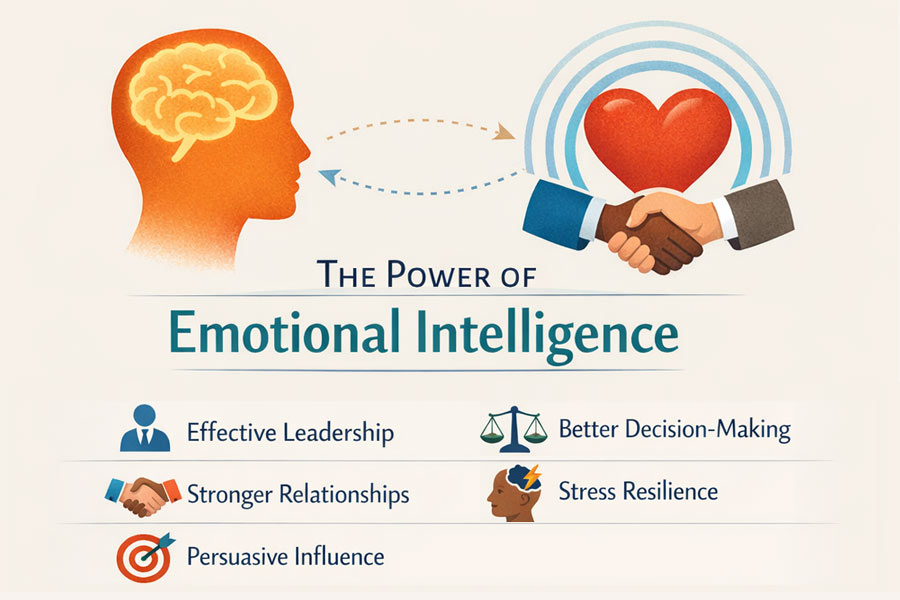
A growing body of research shows that emotional intelligence (EI) is a stronger predictor of long-term success than raw cognitive ability.

  1. EI Drives Leadership Effectiveness

Studies across industries show that top-performing leaders consistently score higher in emotional intelligence than their peers. They communicate more clearly, resolve conflict more effectively, and create environments where people feel understood and motivated.

  1. EI Strengthens Relationships

Whether in business or personal life, relationships thrive on trust, empathy, and attunement. People with high EI read social cues more accurately and respond in ways that build connection rather than friction.

  1. EI Fuels Persuasion and Influence

Persuasion is not about delivering more information; it’s about delivering the right information in a way that resonates emotionally. EI helps communicators understand what matters to others and tailor their message accordingly.

  1. EI Supports Better Decision-Making

Contrary to the myth that emotions cloud judgment, emotional intelligence helps people integrate emotional data with rational analysis. This leads to more grounded, human-centered decisions.

  1. EI Predicts Performance in High-Stress Roles

In fields like healthcare, sales, and leadership, the ability to stay composed, empathetic, and adaptable under pressure is often more valuable than technical expertise alone.

Persuasive Communication Training Builds Emotional Intelligence

While some people seem naturally attuned to others, emotional intelligence is not an innate gift; it’s a skill set. As with any skill, it can be strengthened through deliberate practice.

Persuasive communication training is one of the most effective ways to develop EI because it empowers individuals to:

  1. Practice Deep Listening

True persuasion begins with understanding. Training that emphasizes listening, rather than talking, helps people tune into emotional cues, motivations, and unspoken concerns.

  1. Build Empathy Through Perspective-Taking

Persuasion frameworks often require communicators to step into the other person’s world. This strengthens empathy, one of the core pillars of emotional intelligence.

  1. Regulate Emotional Responses

Difficult conversations, objections, and high-stakes interactions demand emotional self-management. Communication training teaches people to stay grounded, curious, and constructive.

  1. Communicate With Clarity and Attunement

Emotionally intelligent communicators adjust their tone, pacing, and message structure based on the listener’s needs. Training helps people become more intentional and adaptive.

  1. Develop Confidence Without Aggression

Persuasion is not force. It’s alignment. Training helps individuals express themselves with confidence while maintaining respect and psychological safety.

Emotional intelligence is not simply a “nice-to-have.”

EI is a core competency for anyone who wants to lead effectively, build trust, or influence others with integrity.  Because EI can be developed, the path forward is clear:

  • Learn to listen deeply
  • Understand emotional cues
  • Communicate with empathy
  • Regulate your reactions
  • Practice attuned, human-centered, persuasion

In a world overflowing with information, it’s emotional intelligence, not IQ, that determines who gets heard, who gets trusted, and who ultimately makes an impact.

AIM MarketingEmotional Intelligence Outperforms IQ in Predicting Success
read more
Listen Up!

Listen Up!

What the Stoics Teach Us About Removing Barriers to Genuine Conversation

The Stoics believed that most of our suffering comes not from events themselves, but from the stories we tell about them. Nowhere is this more evident than in the way we communicate. Epictetus reminded his students that “We have two ears and one mouth so that we may listen twice as much as we speak.” Marcus Aurelius warned against letting ego distort another’s perception of us.

And yet, in modern conversation, ego often takes the wheel.

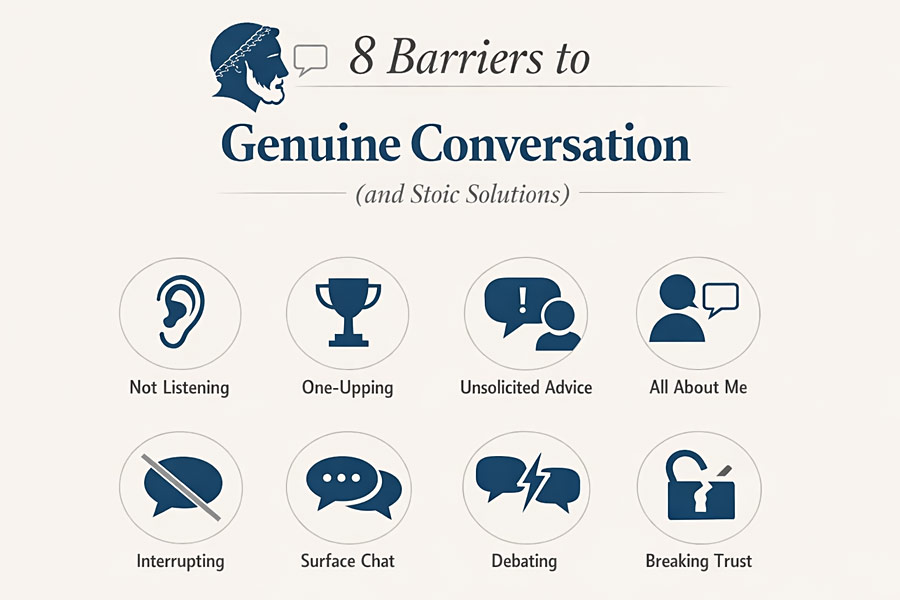
If we want to build trust, connection, and influence, the very heart of persuasion, we must remove the subtle habits that turn conversations into competitions, monologues, or emotional minefields. Below are eight conversation barriers the Stoics would urge us to eliminate, along with the alternative behaviors that create genuine connection.

  1. Waiting for Your Turn to Talk

Stoics taught presence. But many conversations today are parallel monologues, two people waiting for their turn rather than listening.

When you’re simply queuing up your next point, the other person feels it. The exchange becomes transactional, not relational. Eventually, they stop sharing anything meaningful because they sense you’re not actually with them.

Stoic alternative: Pause before responding. Ask a follow‑up question before sharing your own experience. This signals to your counterpart ‘Your words matter. I’m here with you.’

Listening is the highest form of respect. It is a silent compliment.

  1. One‑Upping Every Story

Someone shares a struggle; you share a bigger one.

They share a win; you share a better one.

You think you’re bonding through shared experience.

They feel erased.

One‑upping is often insecurity in disguise: the ego scrambling to stay impressive. But as the Stoics remind us, other people’s victories do not diminish our own.

Stoic alternative: Validate their experience. Let their moment be their moment.

Awareness is the first step to breaking the habit.

  1. Giving Unsolicited Advice

People rarely share their problems because they want solutions. They share because they want to be seen, heard, and understood.

When you jump to advice, you skip the part they needed most. Sadly, it communicates: your feelings aren’t important. Let’s get to fixing this.

Stoics understood that discomfort with another’s pain is our discomfort, not theirs. Rushing to solve it is a way to escape our own unease.

Stoic alternative: Ask: ‘Do you want to talk through solutions, or do you just need someone to listen?’

Then honor their answer.
Sometimes the most helpful thing you can do is nothing.

  1. Bringing Every Topic Back to Yourself

When every conversation becomes a launchpad for your stories, people stop sharing. They feel hijacked.

Ego wants to center itself. Stoicism asks us to decenter ourselves.

Stoic alternative: Show genuine interest in their inner world.

If you share a related story, keep it brief, then return the focus to them. Listen, not to respond, but to understand.

  1. Interrupting or Finishing People’s Sentences

This is a form of ‘expert override’: the assumption that you already know where they’re going and can get there faster.

It communicates: my thoughts are more valuable than waiting for you to complete yours.

Interruptions rob people of agency. They derail complex thoughts. They reveal impatience, which the Stoics considered a failure of discipline.

Stoic alternative: Practice deliberate pauses. Let their message land fully. Embrace silence; it is not empty. It is respectful.

  1. Asking Only Surface‑Level Questions

Closed‑ended questions keep conversations safe but sterile. They produce pleasantries, not connection.

Stoics valued curiosity about the inner life: what moves people, troubles them, shapes them.

Stoic alternative: Replace status questions “What do you do?” with experience questions “What’s been on your mind lately?”

Invite people to be seen. Most are desperate, but won’t ask for it.
Real connection requires risk.

  1. Turning Everything into a Debate

When every idea is challenged, contradicted, or corrected, people stop sharing, not because they can’t defend their views, but because they don’t want to.

You may think you’re sharpening their thinking.

They feel exhausted.

Stoics valued truth, but they valued relationships more.

Not every incorrect statement needs correction.

Stoic alternative: Ask yourself “Does this response serve the relationship or my ego?” Value the person more than winning the point.

  1. Sharing Private Information

Whether framed as concern or “seeking advice,” sharing someone’s private story without permission is a breach of trust.

Trust doesn’t just break, it shatters.

People don’t simply feel betrayed; they feel exposed.

In Stoic terms, this is a failure of integrity.

Stoic alternative: Guard what others share with you. Treat it as sacred.
The foregoing are excellent ways to address the “care and connection gaps” at the heart of The Persuasion Blueprint.

A Stoic Exercise: Remove One Barrier

Pick one habit you recognize in yourself.

For two weeks:

  • Notice when you do it
  • Catch yourself
  • Choose the alternative behavior

Watch what happens when you remove even one barrier.
Conversations deepen. People open up. Trust grows.
And your influence expands, not through force, but through presence.

As the Stoics taught, persuasion begins not with speaking, but with listening. So up your listening. You’ll be pleased by what turns up!

AIM MarketingListen Up!
read more
What’s Your Persuasion?

What’s Your Persuasion?

There is no one right way to persuade, only one right way for you. Persuasion is not a rigid formula but a living art, shaped by personality, context, and the unique way you connect with others.

While there are countless skills and mindsets that can influence outcomes, each of us naturally gravitates toward a style that feels authentic. And authenticity, more than anything else, is what makes persuasion powerful.

Rita’s Story: Calm Confidence at the Health Club

At one of the Health Clubs where I worked, its consistently top salesperson was Rita (not her real name). On paper, she didn’t fit the stereotype of a persuasive communicator. She was slight of build, her English was limited, and her energy level seemed low compared to the high-octane personalities around her. Yet Rita consistently outsold everyone else in the company.

What was her secret? Rita had an uncanny ability to put people at ease. Her calm demeanor created a sense of control for the prospect. Instead of feeling pressured, they felt safe. Instead of being “sold,” they felt invited. Rita’s persuasion style was rooted in emotional regulation and presence; skills that allowed her prospects to relax, trust, and ultimately commit. She proved that persuasion isn’t about volume or charisma; it’s about resonance.

The Many Faces of Persuasion

Rita’s success highlights one truth: persuasion is deeply personal. Let’s look at how others have harnessed different skills to influence and inspire.

  1. The Body Language Expert

Consider a manager leading a team through change. By consciously using open gestures, steady eye contact, and mirroring the posture of team members, she communicates empathy and alignment. Her body language says, “I’m with you,” which reduces resistance and fosters collaboration.

  1. The Active Listener

A counselor working with families doesn’t rely on long speeches. Instead, he listens deeply, labels emotions (“It sounds like you’re feeling overlooked”), and reflects back what he hears. This active listening validates the client’s experience, building trust and opening the door to constructive solutions.

  1. The Questioner

A consultant persuading executives often uses effective questioning techniques. Instead of pitching solutions outright, he asks: “What would success look like for you in six months?” By guiding leaders to articulate their own goals, he positions his recommendations as natural extensions of their vision. The persuasion lies in co-creation.

  1. The Translator

A teacher introducing complex science concepts to students knows that attributes alone don’t persuade. She translates attributes into benefits: “This formula isn’t just math, it’s the key to predicting weather patterns.” By reframing technical details into meaningful outcomes, she sparks curiosity and commitment.

  1. The Resistance Navigator

A negotiator recognizes the three types of resistance: identity, emotional, and intellectual. When a counterpart resists out of pride (identity), he acknowledges their expertise. When emotions flare, he slows the pace and validates feelings. When intellectual objections arise, he provides data. By tailoring his response, he keeps dialogue moving forward.

  1. The Sensory Connector

A marketer pitching a new product notices her client is highly visual. Instead of talking in abstract terms, she uses vivid imagery: “Imagine walking into your office and seeing this sleek design on your desk.” By aligning with the client’s processing style, visual rather than auditory, she makes the message stick.

  1. The Voice Artist

A public speaker persuades not just with words but with tone, inflection, and resonance. By lowering his voice at key moments, pausing for effect, and emphasizing positively charged words, he creates emotional impact. His audience doesn’t just hear the message, they feel it.

  1. The Embracer of “No”

Finally, consider the salesperson who learns to embrace “no.” Instead of seeing rejection as failure, she treats it as feedback. Each “no” clarifies what the prospect values, allowing her to refine her approach. Over time, those “no’s” become steppingstones to genuine commitment.

Your Persuasion, Your Way

The skills of persuasion: body language, pacing, mirroring, labeling emotions, questioning, translating attributes into benefits, navigating resistance, recognizing processing styles, differentiating types of “yes,” and mastering tone are all tools in a vast toolkit. But the way you use them will be uniquely yours.

Rita didn’t rely on high energy or perfect English. She relied on calm presence. Others lean on questioning, listening, or storytelling. The point is not to master every skill at once, but to discover which ones align with your natural style and context.

So, what’s your persuasion? The answer lies, not in copying someone else’s formula, but in uncovering the authentic way you connect, influence, and inspire.

AIM MarketingWhat’s Your Persuasion?
read more